


Wugongshan Mountain, with its highest peak Golden Summit (Baihe Peak) at 1,918.3 meters, spans Pingxiang, Ji’an, and Yichun in Jiangxi. Famous for its vast high-altitude meadows (over 100,000 mu), spectacular sea of clouds, sunrise, and starry skies, it has become a “paradise” and social media hotspot for outdoor trekking and camping enthusiasts in China.
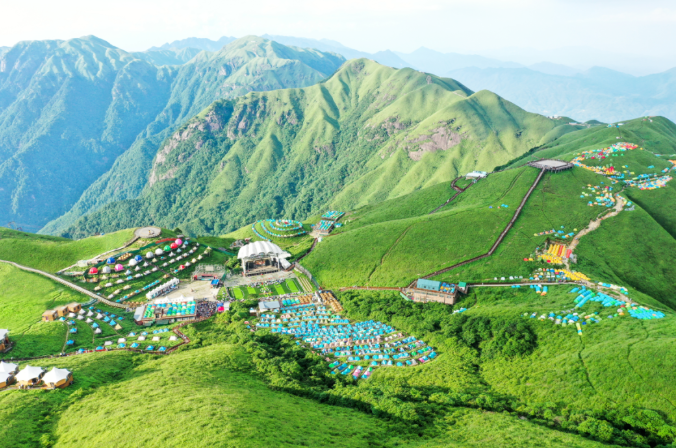
Its most unique feature is the endless stretch of alpine meadows above 1,600 meters—rare at this latitude—turning green in spring and summer, golden in autumn, and silvery in winter, beautiful year-round. Geologically, it features granite domes and peak forest landscapes. Historically, it was also a sacred site for Buddhism and Taoism; the ancient altar group on Golden Summit (like Gexian Altar and Wangxian Altar) dates back over 1,700 years, a living fossil of ancient sacrificial culture in southern China.
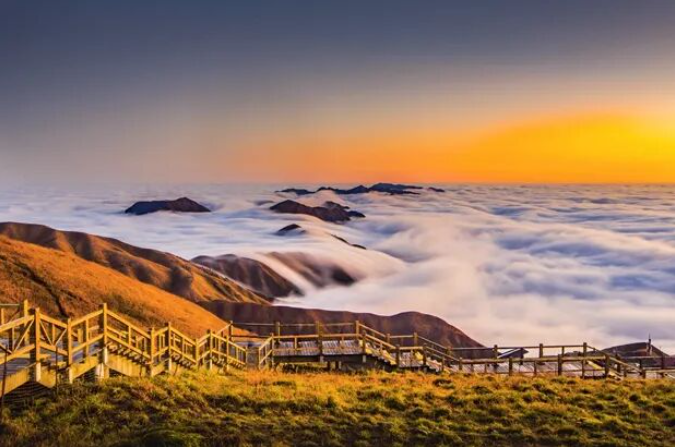
The core experience is trekking. The classic reverse route (Longshan Village–Fayunjie–Golden Summit) takes 2–3 days, passing famous sections like Despair Slope and Hero Slope, all traversing stunning meadows. Alternatively, take two cable cars to Golden Summit for an easier visit. Accommodation is basic, mostly guesthouses or tents. Watching the sea of clouds at sunrise and stargazing at night are must-dos. Best from May to November, with May for azaleas and September–October for clear autumn skies. Weather changes quickly; bring rain gear and warm layers. The transport hub is Pingxiang North Station (high-speed rail) or Pingxiang Station, with buses to the scenic area.