


At an average altitude of 795 meters, Lauterbrunnen lies on the western side of the Jungfrau region, flanked by nearly vertical cliffs. Its most breathtaking feature is the series of waterfalls cascading from the towering rock faces. According to local lore, there are “72 waterfalls,” one of which is the Trümmelbach Falls.
Staubbach Falls plunges 300 meters, making it one of Switzerland’s highest free-falling waterfalls. Due to its immense drop, the water is often dispersed by the wind mid-air, turning into fine mist that resembles dust. Its German name, Staubbach, means “dust waterfall.” During the summer, when water flow is abundant, visitors can follow a path carved into the rock to walk behind the falls, gazing out at the valley through the curtain of water. The roar of the water, the chill of the mist, and the solid feel of the rock all strike the senses at once.
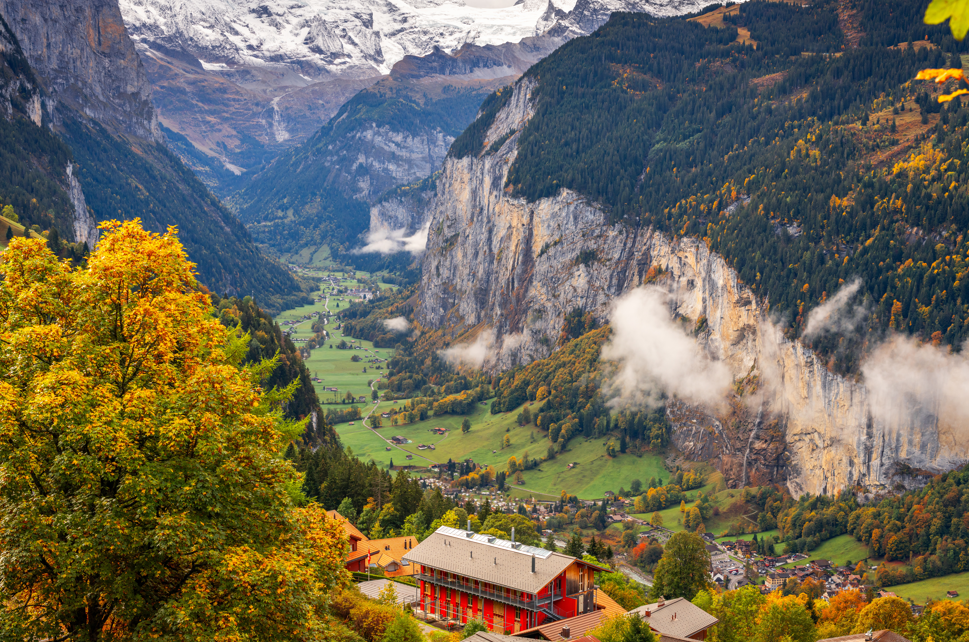
Lauterbrunnen Valley. Source: Tuchong
The Trümmelbach Falls, however, are an even rarer natural wonder: they are the only glacial waterfall in Europe that is located inside a mountain and open to the public. Entirely hidden within the mountain, this waterfall roars with a flow of 20,000 liters per second, carrying around 20,000 tons of debris annually. Glacial meltwater cascades down ten internal tiers, thundering through narrow rock fissures with a resounding echo. The falls are part of the Jungfrau-Aletsch UNESCO World Heritage Site. Since they rely on glacial meltwater, they are only open from May to early November; winter cold freezes their source, and the falls fall silent.
From the valley floor, a cable car ascends to the car-free village of Mürren, perched at 1,650 meters on a cliff ledge. Facing the triple peaks of the Jungfrau, Mönch, and Eiger, residents can simply open their windows to a panoramic mountain vista.
Beyond its natural beauty, this valley carries cultural significance. In 1911, the British author J. R. R. Tolkien traveled here. Scholars have noted striking similarities between the valley’s landscape—towering cliffs on either side, cascading waterfalls, and a deep, serene gorge—and Rivendell, the elven stronghold depicted in The Lord of the Rings. Tolkien himself mentioned in a letter that his 1911 adventures in Switzerland provided inspiration for Bilbo’s journey through the Misty Mountains in The Hobbit. Some researchers have also observed that the phonetic qualities of “Lauterbrunnen” bear resemblance to the “Loudwater” and the Elvish name “Bruinen” found in his works.