


Located in the Bernese Highlands at an elevation of 4,158 meters, the Jungfrau is the centerpiece of the "Jungfrau-Aletsch Glacier" UNESCO World Heritage site. Although not the highest peak in the Alps, it is celebrated as the "Queen of the Alps" for its unique location and stunning vistas.
Flanking the Jungfrau are the Eiger (3,970 m) and the Mönch (4,107 m). These three peaks form a majestic wall in a straight line. The Eiger’s north face is one of the steepest and most dangerous rock faces in the Alps. Local legend weaves a tale of love and separation: the Eiger, a "young man" in love with the Jungfrau, is separated from her by the Mönch—nature and human emotion intertwined.
Another awe-inspiring natural feature is the 23-kilometer-long Aletsch Glacier, the longest glacier in the Alps. Flowing slowly from the north slopes of the Jungfrau, Mönch, and Eiger, it forms an immense ice field. The region was designated a UNESCO World Natural Heritage site in 2001.
Human presence in this harsh environment is legendary. Construction of the Jungfrau Railway began in 1896 and was completed 16 years later in 1912. Its terminus, Jungfraujoch Station, sits at 3,454 meters above sea level, making it the highest railway station in Europe and earning the commercial nickname "Top of Europe." At the Eiger Glacier station along the way, large viewing windows allow passengers to gaze directly at the glacier and abyss of the Eiger’s north face—a route once climbed by mountaineers risking their lives, now easily glimpsed from a warm carriage.
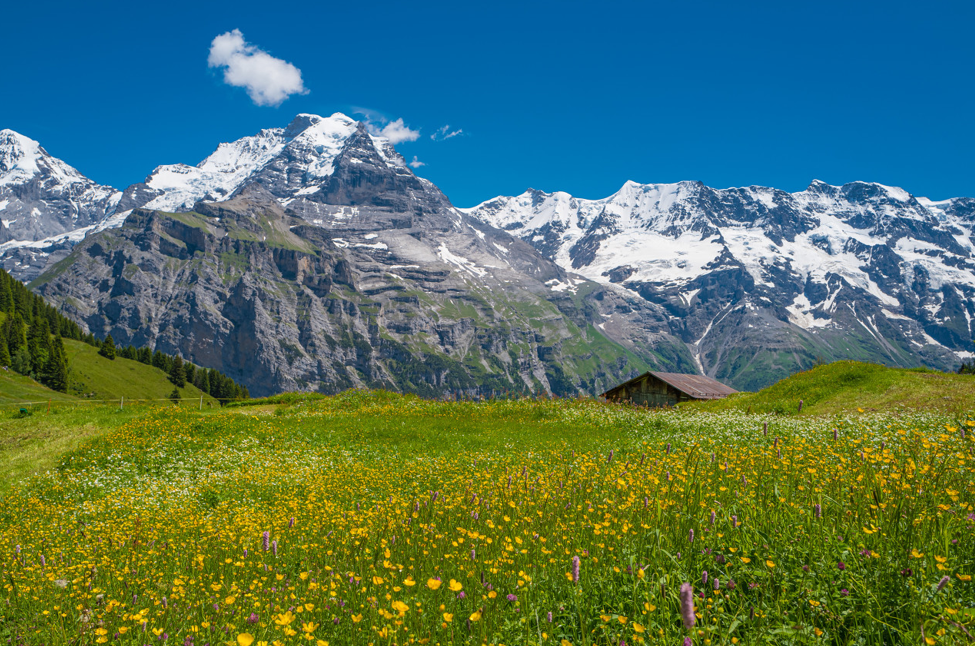
Jungfrau Image Source: Tuchong
From the Sphinx Observatory at 3,571 meters, visitors can enjoy a 360-degree panoramic view of the Aletsch Glacier. Inside the mountain, the Ice Palace is a man-made cavern carved into the glacier, with temperatures maintained year-round between -3°C and -5°C. Walking through it, one can touch ancient ice formed over centuries—a direct dialogue between nature and human engineering.
Of special note is the Eastern connection to this iconic European mountain. In 2002, the Jungfrau and China’s Huangshan Mountain became sister mountains. In 2008, Interlaken at the foot of the Jungfrau and Huangshan City were established as sister cities. Separated by thousands of miles, these two mountains are united by their shared majesty and beauty.
Editor Ⅰ: Zhang Congxiao
Editor Ⅱ: Bao Gang
Editor Ⅲ: Pan Kaiyue