


Overlooking the Lake Lucerne region, Mount Pilatus reaches its highest point at the Tomlishorn, 2,128 meters above sea level. Composed of several peaks, its rock layers are primarily sandstone and limestone, belonging to the nappe fold structures on the northern edge of the Alps. The geological profile here clearly records the processes of Alpine orogeny, making it an important area for geological research.
But what draws the most attention to Mount Pilatus is not its height or rock formations, but the legend of a dragon that haunts the mountain.
As early as the Middle Ages, local folklore told of giant flying dragons living here. It is said that in 1499, a "dragon stone" bearing the image of a dragon fell from a cliff and was believed by locals to possess magical powers. Even today, murals depicting these stories line the rock faces of the "Dragon Path" near the summit. These legends did not arise from nowhere. The steep cliffs, the mist that clings to the mountain year-round, and the occasional howl of wind through the valleys all evoke the presence of some mysterious creature. In this way, the mountain's very topography gave birth to a folk belief that has endured for centuries.
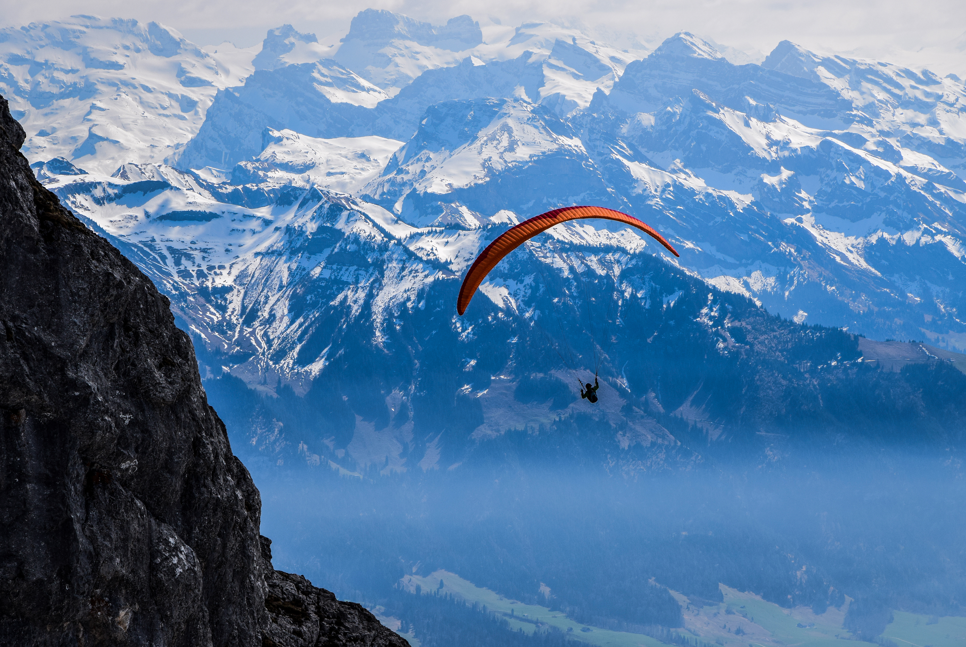
Mount Pilatus Image Source: Tuchong
Mount Pilatus is also home to an engineering marvel: the cogwheel railway from Alpnachstad, built in 1889, with a maximum gradient of 48% (equivalent to an angle of about 25.6 degrees), making it one of the steepest cogwheel railways in the world. Sitting in the carriage, leaning slightly back, watching trees and grassy slopes slide past at a nearly vertical angle—this experience offers a different understanding of a mountain: not conquering it, but inching up its spine, meter by meter.
The "Golden Round Trip" on Mount Pilatus is a classic Swiss tour: take a boat from Lucerne across Lake Lucerne, switch to the cogwheel railway to ascend to the summit, then descend by aerial cable car. This single route brings together lake views, mountain scenery, historical legends, and engineering marvels. Walking along the "Dragon Path" at the summit, with damp rock walls, weathered murals, and the distant Lake Lucerne appearing and disappearing in the clouds—at that moment, the boundary between legend and reality seems to blur.
Editor Ⅰ: Zhang Congxiao
Editor Ⅱ: Bao Gang
Editor Ⅲ: Pan Kaiyue