


As the westernmost section of the Italian Alps, this mountain range is characterized by towering, majestic peaks, countless snow-capped summits, and an exceptionally high average elevation. It is home to Mont Blanc, standing at 4,810 meters on the border between Italy and France, which serves as the iconic core of the entire Western Alps.
The Pennine Alps stretch along the border, with Mont Blanc as their landmark, forming a natural geographical barrier between France and Italy. The continuous white snowcaps remain year-round, the rugged crystalline rock faces stand exposed and stark, and glaciers have carved out broad U-shaped valleys and glacial lakes, creating a landscape that is both frigid and magnificent. This region is also one of the most glacier-concentrated areas in the entire Alps. The biting winds, vast snowfields, and hard rock walls together form the purest alpine extreme-cold landscape in Europe.
In the east-central part of the Pennine Alps, northeast of the Mont Blanc massif, lies the renowned Monte Rosa massif.
Spanning the border between Switzerland and Italy, its main peak, Dufourspitze, rises to 4,634 meters, making it the second-highest peak in the Alps. The entire massif is vast, continuous, and imposing, with broad, gently sloping snowfields spreading extensively, representing the most spectacular high-altitude snowfield highland in the Alpine region.
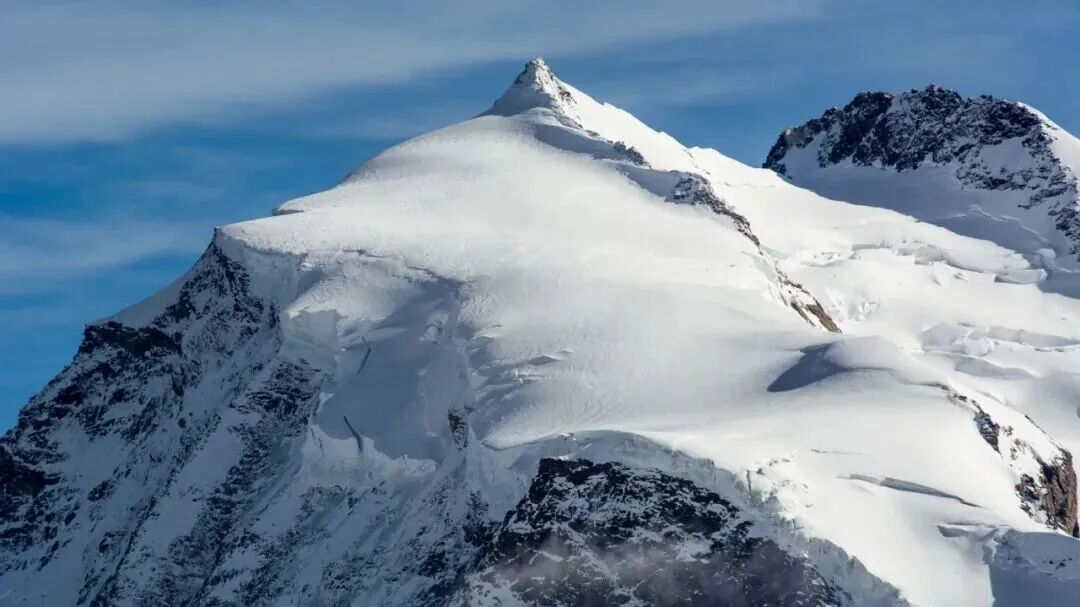
Image: Monte Rosa massif. Source: Swiss Consulate General in Shanghai
The entire Piedmont Alps are predominantly composed of hard crystalline rock, characterized by steep terrain and extensive glaciers. They serve not only as a natural national boundary but also as a vital water conservation area for northern Italy.
As temperatures rise in spring and summer, the high-altitude snow and mountain glaciers slowly melt, converging into clear rivers that continuously supply freshwater to the south, silently nourishing the foothill valleys and the Po Plain.
This majestic and imposing western mountain section lacks the gentle, meandering curves of rolling hills; instead, it offers only the stark, resilient lines of snow-covered peaks. It persistently supplies water to the Po Plain while shaping a grand, solemn, and magnificently vast alpine landscape for northern Italy.
Editor Ⅰ: Yuan Jiali
Editor Ⅱ: Bao Gang
Editor Ⅲ: Pan Kaiyue