


France has volcanoes too. They are in the Massif Central (Le Massif Central). This is the largest inland highland region in mainland France, sprawling across the south-central part of the country and covering nearly 15% of France's mainland territory. Its highest peak, Puy de Sancy, reaches 1,885 meters. The mountain's bedrock was formed during the Hercynian orogeny, making it one of France's oldest mountain massifs. The entire region is dotted with ancient volcanic relics, making it a natural volcanic geological museum in Europe.
The most representative feature is the Chaîne des Puys (the Chain of Volcanoes), a narrow belt lined with dozens of ancient volcanic cones. This area was officially designated a UNESCO World Heritage site in 2018. Among them, the Puy de Dôme offers a wide, open view, allowing visitors to overlook the continuous volcanic cluster and boundless green landscapes from its summit. Lac Pavin was formed by water accumulating after an ancient volcanic eruption; its surface is clear and serene, blending perfectly with the surrounding scenery.
This highland region is known as the "Green Heart of France." Forests, meadows, river valleys, and pastures stretch across the land, creating a rich and natural ecological fabric. Several of France's major rivers originate here, including the Loire River, which begins its journey from the heart of the highlands and nourishes vast central territories along the way. The local people have relied on the mountains for agriculture and livestock for generations, producing cheeses and other ingredients with a uniquely rich flavor characteristic of the highlands.
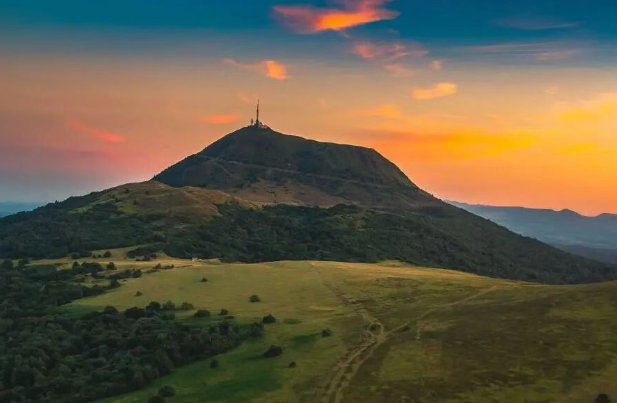
Image: Chaîne des Puys (Source: iStock-Ocni Design, Alexandre Bauer)
In 53 BC, Vercingetorix, the leader of the Gallic tribes, united the tribes here to resist Caesar's Roman legions. Standing on the volcanic summit overlooking this land, two thousand years of history suddenly gain a sense of depth and perspective.
The mineral deposits of the Massif Central are also worth mentioning. The coal resources here once supported the steel industry of Saint-Étienne. Even more famous is the kaolin clay from Limoges — porcelain made from it represents the pinnacle of French craftsmanship.