


Between the karst peaks and the Hongshui River, a bowl of rice noodles holds the roots of a thousand-year rice-cultivation civilization and the vibrant essence of multi-ethnic integration.

Guangxi Karst. Source: Tuchong
The reliance of Guangxi people on rice noodles is etched into their very bones. A well-known saying in Guangxi goes: "One can go three days without meat, but not a single day without rice noodles." From dawn to late night, noodle stalls line the streets and alleys, with the sound of noodle-slurping echoing everywhere. The richness and diversity of Guangxi's rice noodles are not merely a matter of "deliciousness"—they represent a flavor code of how a region nourishes its people, a culinary landscape shaped by terrain, climate, and ethnic wisdom.
The Gift of the Land
The "Foundation of Noodles" Amidst Karst Mountains and Waters
To understand the myriad forms of Guangxi's rice noodles, one must first read the land itself. Guangxi has been an important birthplace of rice-cultivation civilization since ancient times. In 2012, a research team from the Chinese Academy of Sciences published a paper in Nature journal, proving that the wild rice most closely related to cultivated rice exists in the area around Nanning, Guangxi. The ancestors of the Zhuang people toiled tirelessly in the fields, living by "Na" (the Zhuang word for "paddy field"), turning rice into their way of life.
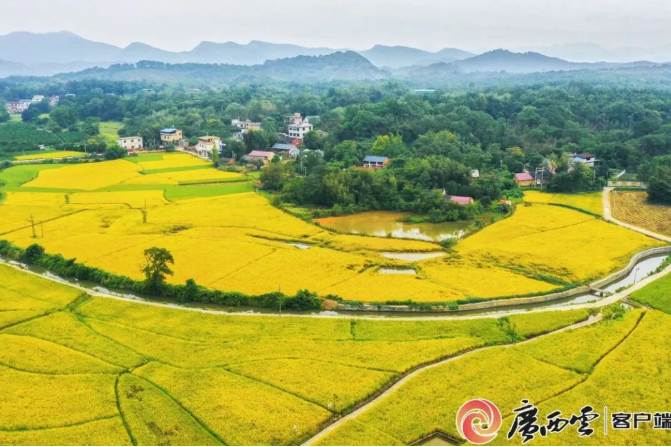
Rice paddies in Quanzhou, Guangxi. Source: Guangxi Cloud - Guangxi Daily, Photo by Tang Guangdong
Guangxi's geographical pattern of "80% mountains, 10% water, and 10% farmland" has created regional diversity. Northern Guangxi has high mountains and cold waters; central Guangxi is undulating hills; southern Guangxi borders the sea; and western Guangxi features continuous peak clusters. This geographical variation directly determines the varieties and textures of rice in different regions, which in turn affects the taste and craftsmanship of rice noodles. One could say that the texture of a bowl of noodles is written by the land from the very moment the rice seed falls.
Northern Guangxi
The Richness Nurtured by Lijiang River Water and Karst
Northern Guangxi is centered around Guilin, a corner with deep historical roots in Guangxi's rice noodle landscape. The history of Guilin rice noodles can be traced back over two thousand years. Legend has it that when Emperor Qin Shi Huang excavated the Lingqu Canal and campaigned in Lingnan, military cooks brought the technique of making millet noodles from the north to Lingnan, combining it with local rice to form the prototype of today's Guilin rice noodles. The Lingqu Canal connected the Xiang River and the Lijiang River, bridging the Central Plains and Lingnan. Rice noodles entered Guangxi through Guilin and then spread southward—making Guilin the "estuary" of Guangxi's rice noodles.
What truly makes Guilin rice noodles unique is the distinctiveness bestowed by the geographical environment. Lijiang River water, filtered through layers of karst limestone, is slightly alkaline. Noodles made with this water are fine, white, soft, and smooth, with a pleasant chewiness. Even with the same techniques and rice, this texture cannot be replicated outside Guilin. At three or four in the morning, noodle workshops begin grinding rice milk and steaming sheets, delivering freshly made noodles to noodle shops before dawn—a "same-day freshness" tradition that has continued for two thousand years.
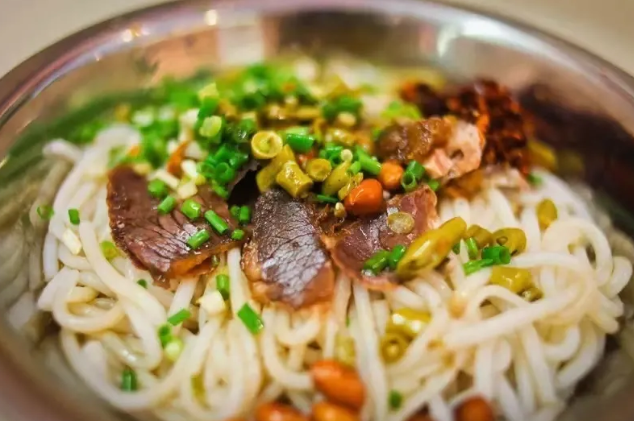
Guilin rice noodles. Source: Guilin Evening News
The soul of Guilin rice noodles lies in the spoonful of seasoned brine, which is simmered for over ten hours with beef bones, pork, and more than ten types of spices. Luo Han Guo from Yongfu, cassia bark from Fangchenggang, and tsaoko from western Guangxi—a single spoonful of brine gathers the essence of Guangxi's landscapes from north to south. Old Guilin locals often say, "Mix the noodles for one minute, eat them in thirty seconds." The essence of brine noodles lies in "dry tossing," ensuring every strand of noodle is evenly coated with the brine. After finishing, a bowl of pork bone clear soup completes the experience. In 2021, the craftsmanship of Guilin rice noodles was inscribed on the National Intangible Cultural Heritage list.
In Guilin, noodles are enjoyed with refinement and attention. Come afternoon, noodle shops gradually close, and the aroma of brine retreats into the depths of old streets. But if you follow the Xiang-Gui Corridor northward past Lingchuan and Xing'an, the scenery gradually shifts—mountains become gentler, accents begin to mix with Hunanese tones, and the culinary character takes on a different face. This corridor has been the official route from the Central Plains into Lingnan since the Qin and Han dynasties, bringing northern noodle culture southward to meet southern rice, giving rise to a distinctly different rice noodle character.
Quanzhou is Guangxi's "North Gate." Setting foot in Quanzhou feels like stepping onto the boundary between Guangxi and Hunan. Quanzhou red-oil rice noodles feature a layer of red chili oil floating on the soup, topped with minced pork and soybeans—the most common breakfast in the area. The noodles are thin and pressed, smooth and clean in texture. The red oil is fried from dried chili peppers, delivering a direct spiciness. The soybeans are deep-fried to crispness, offering a satisfying crunch. The minced pork absorbs the broth, becoming savory and flavorful. As the first stop of Central Plains culture entering Lingnan, Quanzhou's geographical position as a "north-south crossroads" gives its red-oil noodles a character distinct from noodles in southern Guangxi—straightforward, unpretentious, and open.
Central Guangxi
A Bowl of Noodles Forged in an Industrial City
Heading south along the Xiang-Gui Corridor to Liuzhou, this industrial powerhouse of Guangxi carries a spirit of "daring to try and break new ground." Luosifen (river snail rice noodles) emerged in the 1970s and 1980s, making it a relatively young member of Guangxi's rice noodle family—yet it possesses remarkable "boundary-breaking" power.
Regarding the origin of Luosifen, a widely circulated story holds that in the late 1970s, stallholders at Liuzhou's Gubu Street market poured snail soup over rice noodles, adding pickled bamboo shoots, peanuts, fried bean curd sticks, and other toppings, and unexpectedly won great popularity. Its core flavor profile is "sour, spicy, umami, and refreshing." The sourness comes from pickled bamboo shoots, a tradition of "preserving food with sourness" among the Dong and Miao peoples; the spiciness comes from chili oil, a survival wisdom of "using spice to ward off miasma" in Guangxi's humid and hot climate; the umami comes from a slow-simmered broth made with Liujiang river snails, star anise, and cinnamon; the refreshment comes from noodles made with high-quality indica rice from the Liuzhou area, which are springy and elastic.
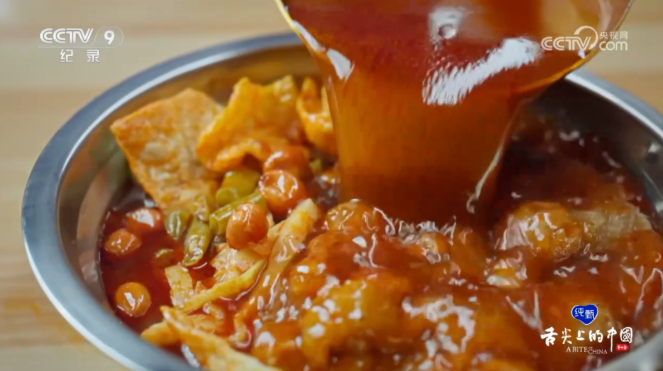
Liuzhou Luosifen. Source: CCTV.com
In 2021, the craftsmanship of Luosifen was inscribed on the National Intangible Cultural Heritage list. In 2024, the total revenue of Liuzhou Luosifen's full industry chain reached RMB 75.971 billion. From street-side stalls to a multi-billion-yuan industry, its rise has resonated with the transformation and upgrading of Liuzhou as an industrial city.
Following the Liujiang River northward to the Miao Autonomous County of Rongshui, hidden deep in the mountains lies another type of noodle. Rongshui strained noodles are made in an ancient and unique way. After mixing the rice milk, it is placed in a perforated wooden ladle and gently shaken above boiling water, causing the rice milk to fall like a waterfall into the pot—made and eaten on the spot, served with roasted meat, barbecued pork, and sour soup. This method is closely tied to the geographical conditions of the Rongshui mountainous region. With high mountains and long distances, the Miao people used locally available materials and simple tools to create delicious noodles. If Luosifen is Liuzhou's masterpiece of "breaking through," then strained noodles are a living fossil "preserved" deep in the mountains.
Editor Ⅰ: Zhang Congxiao
Editor Ⅱ: Zhang Wenwen
Editor Ⅲ: Zhang Yijing