


Kashgar, whose full name is "Kashgar" (meaning "land where jade gathers"), boasts a documented history spanning over 2,000 years.
Surrounded by mountains to the west, south, and east, Kashgar opens northeast toward the Tarim Basin. To the north lie the southern ranges of the Tianshan Mountains, to the west rises the Pamir Plateau, to the south stand the Karakoram Mountains, and to the east stretches the Taklamakan Desert. The terrain slopes from southwest to northeast, with K2—the world's second-highest peak at 8,611 meters—within its borders, while the lowest point in the Taklamakan Desert sits at 1,100 meters above sea level.

Image source: Kashgar Prefecture Media Convergence
Kashgar is not only blessed with stunning scenery but also brims with vibrant local life. Recently, the documentary My Food Guide, produced by the team of Chen Xiaoqing (chief director of A Bite of China and Once Upon a Bite), was released. In this series, Chen steps from behind the camera to the forefront, acting as a guide who takes viewers on a journey to explore regional flavors. His quest goes beyond food, incorporating elements of travel and culture to lead the audience into a wider culinary world.
Kashgar is the third stop on this flavorful journey.
To truly experience Kashgar, start with its most everyday foods. Naan is the most common staple in Xinjiang. While most visitors may find the variety of Xinjiang naan overwhelming, for the people of Kashgar, the "wowo naan" (hollow-centered naan) holds a special place as the "softest part of their hearts."
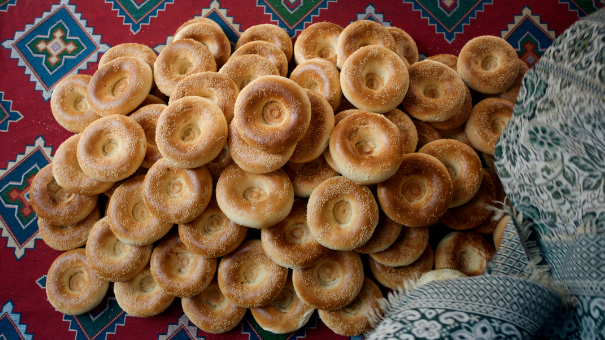
Image source: Documentary "My Food Guide"
Freshly baked wowo naan is at its best. It features a wide, thick rim with a small hollow in the center, a crispy golden crust sprinkled with white sesame seeds. What makes it special is its ability to stay soft for a long time, making it easy to store. Tear it open to reveal the snow-white, fluffy interior—whether eaten plain or dipped in soup, it's an indispensable part of daily life in Kashgar.

Image source: Documentary "My Food Guide"
Heading east from Kashgar into the heart of the Taklamakan Desert, locals prepare a unique bread called "kumachi." Fresh sand is poured into a fire pit, and poplar wood is lit underneath. Once the sand is heated, the pit becomes a natural oven. The bread baked in the sand develops a dry, hard crust from the long baking process, with a golden surface and a rich, toasted aroma. Breaking it open releases savory juices and tender, stewed lamb.
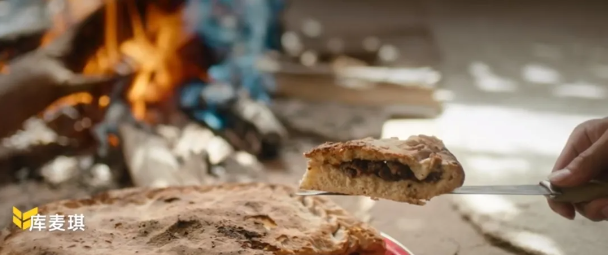
Image source: Documentary "My Food Guide"
The naan oven isn't just for baking bread—it's also used for another Xinjiang classic: baked buns (samsa). A sprinkle of saltwater is splashed onto the oven walls, leaving a frost-like coating that enhances the flavor of the buns. With one bite, the crispy pastry gives way to juicy, well-seasoned minced lamb, infused with the flavors of onions, salt, and pepper.
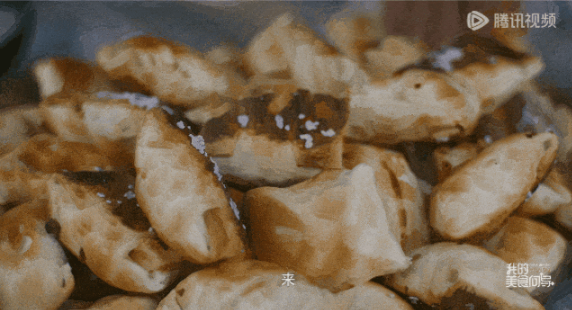
Image source: Documentary "My Food Guide"
"Piyazi" is the local name for onions in Xinjiang, where they play a prominent role. White onions, with their fine texture and mild spiciness, add depth without overpowering other flavors—they're a key filling in baked buns. Xinjiang locals often soak lamb in onion water; the bioactive compounds in onions help remove any gaminess and allow the lamb's natural taste to shine. When eating "kang meat" (pit-roasted meat), crisp white onions are served alongside, creating a delightful contrast in texture. Even the simplest pilaf isn't complete without piyazi.
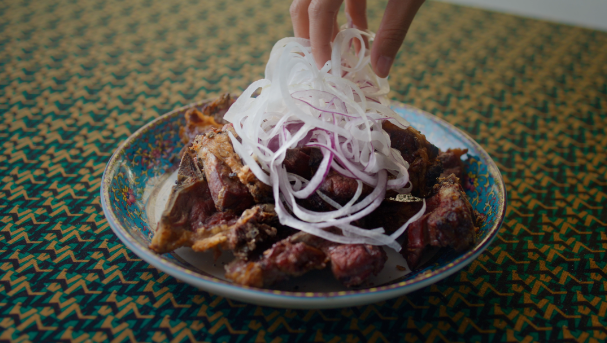
Image source: Documentary "My Food Guide"
Pilaf is an essential staple in Xinjiang—simple yet complex. Every Xinjiang native has their own standard for the perfect pilaf, but one thing is certain: it must include yellow carrots and white onions. Thinly sliced and stirred into a large pot of simmering meat, then cooked with Xinjiang japonica rice, the result is slightly sweet and incredibly satisfying.
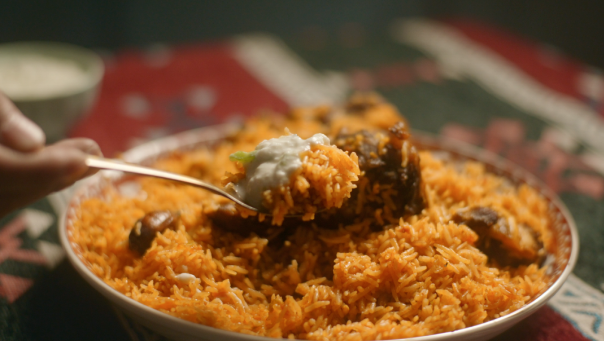
Image source: Documentary "My Food Guide"
In contrast, "yellow pilaf," beloved by Pakistani merchants in Kashgar, replaces yellow carrots with green peppers and adds a variety of spices. It's eaten in a unique way—mixed with yogurt—resulting in a spicy kick that may challenge those not accustomed to heat.
Bazaars in Xinjiang are not just marketplaces but also social hubs. Children are often brought here to learn the art of bargaining through immersion. Stalls selling traditional instruments offer music and dance, while spice shops display eighty-eight varieties of seasonings, many of which are unfamiliar to outsiders.
At the bazaar, try a bowl of "salandoke," a shaved-ice drink locals love in summer. Watch children playing with pets, grandmothers strolling, and elderly couples waiting on tricycles—this is the vibrant tapestry of everyday life.
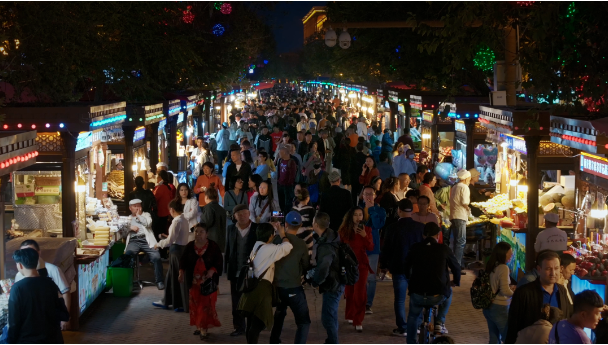
Image source: Documentary "My Food Guide"
After exploring Kashgar's ancient city, head to the nearby Han Bazaar for food. This famous night market gathers a wide array of Xinjiang delicacies and blends influences from various regions. The air is thick with the aroma of roasted meat and spices—a temptation few can resist.
Food reflects the locals' love for life. Kashgar is a city that delights the palate: baked buns, roasted pigeon, grilled lamb, kang meat, "jar meat" (stewed in a mug), rack meat, big plate chicken, pilaf, naan-wrapped lamb... each dish is mouthwatering.
Chen Xiaoqing describes Kashgar as a city "steeped in honey"—not just because its fruits and pastries are sweet, or because its people enjoy sweet flavors, but because beneath the surface, life here is sweet. On this land of song and dance, people grow freely with a passion for music, and their spiritual richness makes life as sweet as honey. This is perhaps Kashgar's most precious and beautiful essence.
Vast and majestic, Kashgar offers diverse landscapes: oases, deserts, poplar forests, glaciers, and snow-capped mountains. It is home to multiple UNESCO Intangible Cultural Heritage elements, such as the "Twelve Muqam" and the Dolan "Meshrep," as well as the Id Kah Mosque—China's largest mosque—and the Stone City in Tashkurgan Tajik Autonomous County, one of the world's four great stone fortresses. The ancient city of Kashgar itself stands as a timeless testament to history.
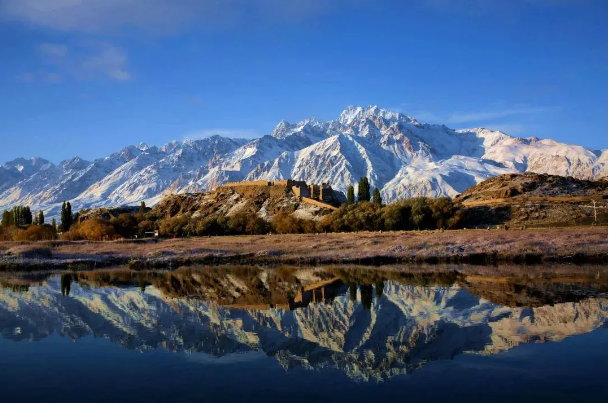
Image source: Kashgar Prefecture Media Convergence
Kashgar is also home to K2, the world's second-highest peak and considered the most challenging to climb above 8,000 meters; the dark, loose-rock-covered Qikolaz Glacier nestled among the Pamir snow peaks; and the mysterious Mogao Stupa, built during the Tang Dynasty and often mistaken by locals for an ancient beacon tower—hence its alternative name, "Moradun," meaning "chimney"...
Kashgar is a fertile gem in the wilderness, a shining pearl on the ancient Silk Road, a city brimming with life and charm, and a vivid window into the Western Regions—worth every mile of the journey to explore.
Editor Ⅰ: Zhang Wenwen
Editor Ⅱ: Bao Gang
Editor Ⅲ: Liu Guosong