


On May 29, the 2026 International Mountain Tourism Day Theme Events opened in Shennongjia Forestry District, Hubei Province. Themed "Preserving World Heritage, Sharing the Prosperity of Famous Mountains — Zhiyin Hubei, Mysterious Shennongjia," the event brought together international organizations, foreign embassies and consulates in China, industry experts, and media representatives from around the world to explore pathways for the coordinated development of ecological protection and cultural tourism. The program featured the Opening Ceremony, the 2026 Dialogue among World Famous Mountains, the Investment and Business Meeting for Mountain Culture and Tourism, and a series of other events. Guests participated in various formats, sharing cutting-edge ideas and deepening practical cooperation. Diego Ezequiel Gamboa, Secretary of State for Tourism, Santa Cruz Province, Argentina, and Julieta Andrea Martín Fabrello, President of the Hotel Association of Santa Cruz Province, Argentina, delivered speeches at the “Dialogue among World Famous Mountains 2026” Exchange and Sharing Session.
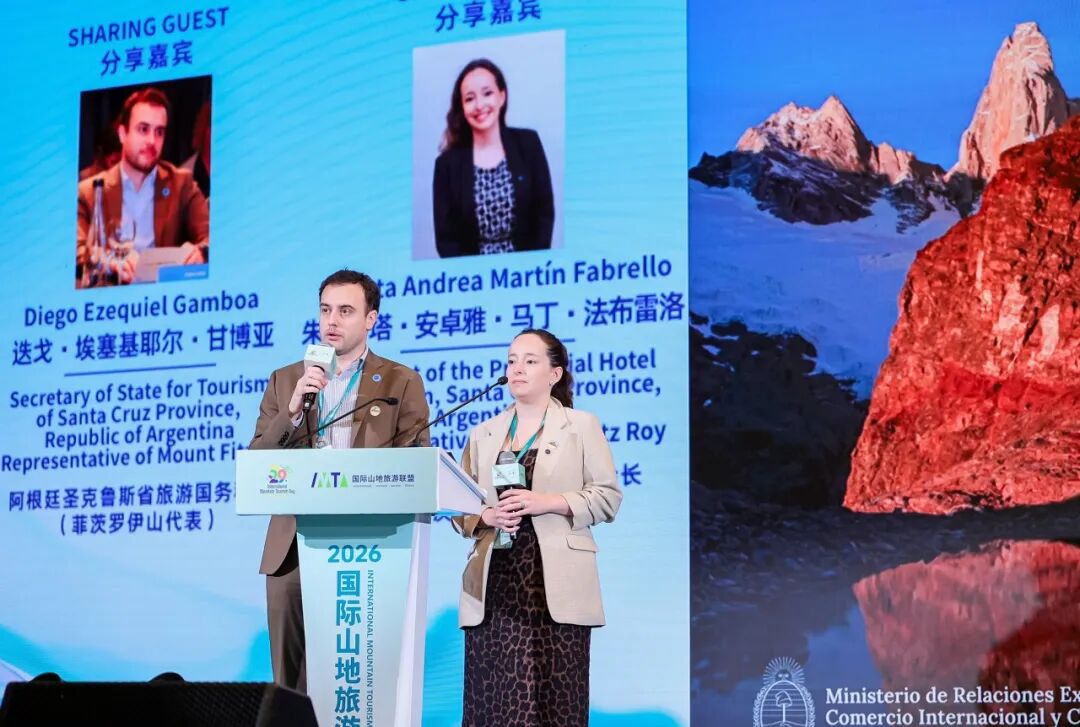
The following is the full text of the speech:
It is an honor to stand before you today representing a region defined by its untamed beauty, massive ice fields, and towering granite peaks. Today, I want to take you on a journey to Patagonia, Argentina — specifically to the province of Santa Cruz. I want to talk to you about a mountain that is not just a geographical wonder, but a global icon of natural heritage, cultural identity, and sustainable tourism management. I am speaking of Cerro Chaltén, internationally recognized as Mount Fitz Roy.
A Towering Giant on the Global Stage
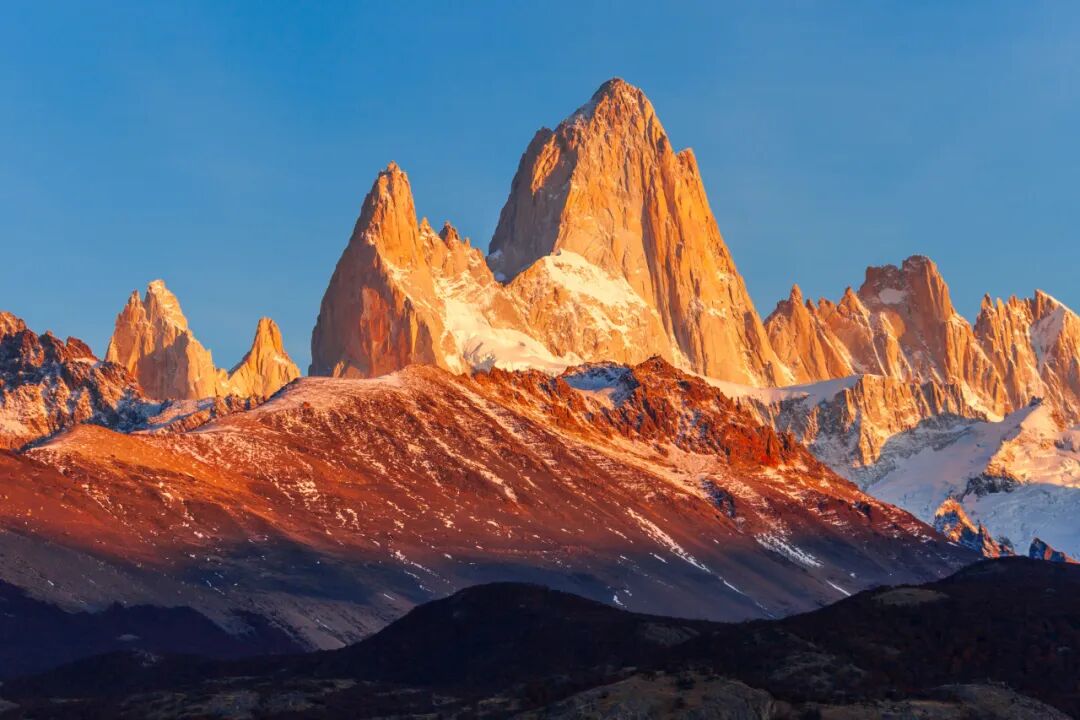
Rising 3,405 meters above sea level, this mountain stands directly on the international border between Argentina and Chile, anchored at the eastern edge of the great Southern Patagonian Ice Field. Geologically, it is a marvel — a massive, isolated granite nunatak piercing through the continental ice sheet. For the global mountaineering community, Fitz Roy represents the ultimate challenge. Its near-vertical, polished, and slippery granite walls — combined with notorious, severe Patagonian winds — make it an objective of extreme technical difficulty. It is, without a doubt, one of the most coveted milestones for climbers worldwide.
A Sanctuary of Legal Protection
But extreme beauty requires extreme protection. The true success of Cerro Chaltén lies in how we balance its global appeal with strict, multi-layered environmental safeguards.
At the international level, the mountain is protected within Los Glaciares National Park, which in 1981 became the very first national park in Argentina to be designated a UNESCO World Heritage Site. Furthermore, it is recognized internationally as both an Important Bird Area and a Key Biodiversity Area by Bird Life International and the IUCN.
At the national level, its fragile ecosystems are legally shielded by robust national frameworks, including National Law 22,351 for National Parks and National Law 26,639 for Glacier Preservation. Argentina manages this area in close alignment with the FAO Mountain Partnership.
At the provincial level, for us in Santa Cruz, this mountain is sacred. On May 24, 2000, our province enacted Law No. 2,550, officially declaring Fitz Roy a"Provincial Natural Monument". This ensures the highest legal safeguards to preserve its scenic and heritage value forever.
Across the border, this commitment is mirrored on the Chilean side within the Bernardo O'Higgins National Park and the "Cordillera del Chaltén" Natural Site.
Deep Cultural Roots and Regional Pride
Beyond the rock and ice, this mountain holds a profound cultural soul. Long before European explorers arrived, the ancestral Aonikenk, or Tehuelche people, named it Chaltén, which translates to"smoking mountain". They called it this because its summit is constantly cloaked in heavy clouds, making it resemble a volcano. To the indigenous peoples, it was a sacred mountain. Today, we are actively driving institutional efforts to recover and prioritize this ancestral name, honoring our deepest roots.
source: tuchong
In 1877, the Argentine explorer Francisco P. Moreno gave it the European name "Fitz Roy" to honor Captain Robert Fitzroy of the HMS Beagle, who had navigated Charles Darwin through these very waters in 1832. This mountain also defined our history, serving as a critical landmark in the boundary demarcation between Argentina and Chile. Today, it is our ultimate symbol of provincial pride — featured proudly on the official flag and the coat of arms of the Santa Cruz Province.
The Capital of Trekking and Sustainable Tourism
So, how does this translate into the local economy? At the foot of these peaks lies the gateway town of El Chaltén. In 2014, via National Law 27,055, this town was officially declared Argentina's"National Trekking Capital".
Right from the edge of the town streets, visitors have immediate access to a world-class network of over 40 distinct trekking circuits. This unique layout has turned tourism into the absolute primary economic driver and livelihood for our local community.
However, popularity brings immense responsibility. Los Glaciares has grown to become Argentina's second most visited national park, welcoming an average of1.5 million visitors in 2024. To manage this massive footprint and protect our wild spaces for generations to come, our National Parks Administration has recently implemented an innovative trail access fee system, ensuring that tourism directly funds environmental conservation.
Conclusion
Distinguished colleagues, Cerro Chaltén / Mount Fitz Roy proves that mountain tourism does not have to choose between economic development and environmental preservation. Through strong legal frameworks, deep respect for indigenous heritage, and adaptive visitor management, we can share the world's most beautiful landscapes while keeping them pristine, wild, and sacred. Thank you very much.
Unless otherwise credited, all text and images are sourced from: International Mountain Tourism Alliance (IMTA)
Editor Ⅰ: Zhang Congxiao
Editor Ⅱ: Zhang Wenwen
Editor Ⅲ: Liu Guosong