


On May 29, the 2026 International Mountain Tourism Day Theme Events opened in Shennongjia Forestry District, Hubei Province. Themed "Preserving World Heritage, Sharing the Prosperity of Famous Mountains — Zhiyin Hubei, Mysterious Shennongjia," the event brought together international organizations, foreign embassies and consulates in China, industry experts, and media representatives from around the world to explore pathways for the coordinated development of ecological protection and cultural tourism. The program featured the Opening Ceremony, the 2026 Dialogue among World Famous Mountains, the Investment and Business Meeting for Mountain Culture and Tourism, and a series of other events. Guests participated in various formats, sharing cutting-edge ideas and deepening practical cooperation. Chen Fang, World Geopark Evaluation Expert, Danxiashan Management Committee of Shaoguan, delivered a speech at the “Dialogue among World Famous Mountains 2026” Exchange and Sharing Session.

The following is the full text of the speech:
Greetings to you all! I am Chen Fang from Danxia Mountain, Guangdong Province. It is a great honor to gather with all of you to discuss the sustainable development of world famous mountains.
The title of my report today is "Cultivating Famous Mountains with Scientific Value and Developing Ecotourism—Danxia Mountain's Practice for the Sustainable Development of World Famous Mountains." Drawing on over thirty years of experience in the conservation and management of Danxia Mountain and twenty years of experience in building it as a World Natural Heritage site and a UNESCO Global Geopark, I will share our team's thoughts, practice, and insights in exploring the path of harmonious coexistence between humanity and nature.
My report consists of four parts: first, the call for sustainable development in our era; second, ways of world famous mountains to lead ecotourism development; third, an introduction to Danxia Mountain as a world famous tourism mountain; and fourth, the specific ecotourism and natural education practice at Danxia Mountain.
I. The Call for Sustainable Development in Our Era
(I) Global Ecological Crisis and the Consensus on Sustainable Development
1. Earth's Ecological Warning
Dear friends, let us first turn our gaze to the deep reaches of the universe. This photo, titled "Pale Blue Dot," was taken in 1990 by Voyager 1 as it looked back toward Earth from six billion kilometers away. Dr. Carl Sagan said that our home, and all our loves and hatreds, exist on this tiny dot. This image serves as a profound reminder that Earth is our only home in the vastness of the universe.
However, the reality is stark. Latest projections show that under current patterns of production and lifestyle, human's rate of resource consumption is causing "Earth Overshoot Day" to arrive earlier year by year. In 2025, it fell on July 24, eight days earlier than in 2024, making it the earliest on record. This chart illustrates Germany's efforts toward sustainable development, but it also underscores that a sustainable world requires immediate action from every country and every individual.
2. International Program of Action
In 2015, the United Nations adopted the 2030 Agenda for Sustainable Development. The over 300,000 protected natural areas worldwide, including more than 2,200 UNESCO-designated sites, are critical to achieving the relevant goals. Latest research indicates that while global wildlife populations are declining, those within protected areas remain relatively stable. Nevertheless, 90% of protected areas still face severe environmental pressures. The United Nations Educational, Scientific and Cultural Organization (UNESCO) calls on us to take action to restore ecosystems and achieve sustainable development.
(II) Practical Guidance from China's "Two Mountains" Theory
The concept that "lucid waters and lush mountains are invaluable assets," put forward by Chinese President Xi Jinping, has charted our course. Ecotourism is the most widespread and dynamic path to implementing this theory. It integrates ecological conservation with economic benefit, mandating ecological protection responsibilities, meeting the public's demand for high-quality ecological products, and facilitating rural revitalization and common prosperity. It also addresses climate change through the "dual carbon" strategy while safeguarding biodiversity.
As shown in the latest research on the semantics of "ecotourism in protected natural areas" by Dr. Li Guiqing from Sun Yat-sen University, the core characteristics of contemporary ecotourism are ecological friendliness, community empowerment, and the dissemination of local knowledge. This is the responsibility that world famous tourism mountains should undertake.
II. Ways of World Famous Mountains to Lead Ecotourism Development
1. World Famous Tourism Mountains: Outstanding Representatives of Protected Natural Areas
World famous tourism mountains are outstanding representatives of protected natural areas globally. Most of China's famous mountains are classified as national parks, nature reserves, or natural parks—areas that concentrate geological features, biodiversity, and cultural values. Our core mission is to protect nature, our primary function is to serve the people, and our ultimate goal is to achieve harmonious coexistence.
2. The Core Value of Ecotourism
So, what is true ecotourism? It is more than just "going out into nature to play." The United Nations World Tourism Organization, The International Ecotourism Society, and the International Union for Conservation of Nature (IUCN) all emphasize its core: responsible travel to natural areas that conserves the environment, sustains the well-being of the local people, and involves interpretation and education. Distinguished from traditional sightseeing, ecotourism requires every visitor to transition from a "passerby" to a short-term "co-builder" of nature and local communities.
In 2025, Contemporary Amperex Technology Co., Limited. and Chinese National Geography jointly released the first "Zero Carbon Destinations · Pioneer List," featuring five sites; in February 2026, the top ten zero carbon destinations were announced. Let's watch the promotional video for the listed destinations. As we just saw, the first selected scenic areas demonstrated the innovative practice in zero-carbon travel, green power application, ecological carbon sequestration, and low-carbon operations, achieving both whole-chain ecological protection and economic growth—true zero-carbon destinations integrate ecological philosophy into every operational detail.
Look at this image. Even for the same natural scene of Danxia Mountain, the explanations from a celebrity tour guide, a science outreach tutor, and a natural education mentor would be vastly different. The former might tell you that this is a pictographic rock and what it looks like, while the latter would guide you to observe the rock stratification, seek out plants in the crevices, and contemplate the process of water erosion. Ecotourism is of unique educational significance. It requires us to convey scientific value, take conservation actions, and carry out meaningful educational activities in nature.
Various types of protected natural areas in China are developing diverse ecotourism models tailored to local conditions. The key lies in legal compliance, scientific planning, community participation, and impact minimization. At Danxia Mountain, we emphasize using all five senses for observation, thinking, experience, and reflection.
III. An Introduction to Danxia Mountain as a World Famous Tourism Mountain
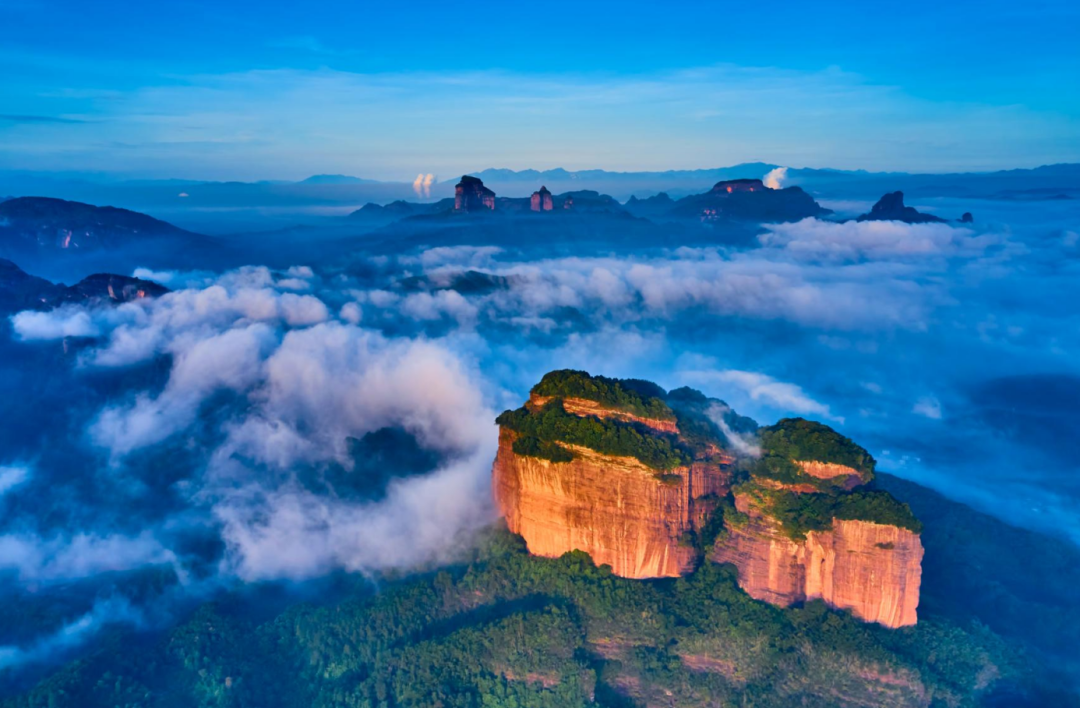
There is a piece of precious history. In 1980, Mr. Xi Zhongxun, then First Secretary of Guangdong Province, emphasized during an inspection that "Danxia Mountain is rich in tourism resources, and there is no time to lose in developing tourism," and that "tourism serves the people." He stressed the need to protect the ecosystem and to plan and manage the scenic area well for the sake of future generations. This guidance, spanning over forty years, aligns perfectly with today's sustainable development concept and has always been the fundamental guideline for our work.
source: tuchong
1. Overview of Danxia Mountain
Next, I will give a formal introduction to Danxia Mountain. Located in Shaoguan, Guangdong Province, Danxia Mountain covers a total area of 292 square kilometers. It is a composite protected area integrating multiple designations: a World Natural Heritage site, UNESCO Global Geopark, national nature reserve, national scenic area, and national 5A tourist attraction. We implement unified management through an administrative committee. Approximately 12,000 residents live here. The multi-brand and multi-faceted attributes present both challenges and unique advantages for our systematic practice of sustainable development.
2. The Four Core Values of Danxia Mountain
Danxia Mountain's status as a world famous mountain is rooted in its four core values:
First, unparalleled aesthetic value. "As red as cinnabar, and as brilliant as rosy clouds"—turquoise waters and crimson mountains provide a visual feast bestowed by nature. We continually interpret and disseminate such beauty through photography, painting, and literary competitions.
Second, Earth science value with global comparative significance. The Danxia landform was named by Chinese scholars. For professionals, we explain its evolutionary stages by using phrases like "a flat top, steep hillsides, and a gentle base;" for the public, we use vivid metaphors like "wearing a straw hat, being bare-chested, and wearing a grass skirt" to make them easier to understand.
Third, unique ecological value. Located in the south subtropical zone, Danxia Mountain has created "island effects" and "heat island effects" due to its special geomorphology, nurturing a distinctive biota. We have discovered 57 new species, most of which are species with extremely small populations found only in Danxia Mountain, such as Firmiana danxiaensis ("Danxia parasol tree") and Danxiaorchis singchiana ("Danxia orchid"), which demonstrate its importance as a treasure trove of biodiversity.
Fourth, profound cultural value. Danxia Mountain boasts a vast cultural heritage, ranging from cliff carvings and ancient villages to the reclusive culture of "building a hut in cloud and mist." We are collaborating with Guangdong Provincial Institute of Cultural Relics and Archaeology to conduct a comprehensive inventory and research project.
Due to these outstanding universal values, China Danxia was successfully inscribed on the World Heritage List in 2010. UNESCO highly commended the site for its superlative natural phenomena under Criterion (vii) and its outstanding illustration of Earth's evolution under Criterion (viii).
3. Achievements in Ecotourism Practice at Danxia Mountain
The World Heritage Committee's resolution fully recognized our conservation and management efforts, urging us to continue scientific research, strengthen biodiversity conservation, and promote international academic exchanges. That's what we have been striving for.
Our efforts have also garnered widespread attention from all sectors of society. From the media-highlighted "study tour craze" and the UNESCO-acclaimed "nature school" construction experience to our collaboration network of 30 sister parks and the training the nation's largest cohort of UNESCO Global Geopark evaluators—the Danxia Mountain model is moving toward a broader global stage.
IV. Ecotourism and Natural Education Practice at Danxia Mountain
Now we move to the core of today's report. How did Danxia Mountain transform the "famous mountain with scientific value" concept into reality?
First, respect historical heritage and lay a solid scientific foundation. From the naming of the "Danxia formation" in the 1920s to the century-long relay of generations of scholars like Academician Chen Guoda, Professor Zeng Zhaoxuan, and Professor Huang Jin, Danxia Mountain has a deep scientific research legacy. This is the cornerstone of our efforts to build it as a famous mountain for science and education.
Second, attract intellectual resources to the mountain to drive continuous innovation. We have established cooperation mechanisms with more than 30 universities and over 100 experts, building a platform for translating research results into popular science. We invite the brightest minds to apply the latest concepts, turning the "genesis of the Danxia landform" into a "play of water and weathering" and "endemic species" into "sagas of survival wisdom."
Third, expand the ranks of science communicators to keep knowledge flowing. Over the past decade, we have recruited more than 600 high-caliber science communication volunteers. For instance, Su Dechen, a researcher at the Chinese Academy of Geological Sciences, is both our scientific advisor and a popular science celebrity with millions of followers. They are the most capable, passionate, and creative individuals, serving as the backbone for promoting Danxia Mountain's value.
Fourth, sustain knowledge production and build learning-based communities. We encourage and support local experts and science mentors to compile textbooks, publish monographs, and develop new courses, creating a continuous knowledge output mechanism. The books in your hands, including Danxia Mountain: Nature's Masterpiece, are the results of these efforts.
Fifth, foster multi-brand synergy to empower management through high standards. From a national scenic area to a UNESCO Global Geopark, and a national 5A tourist attraction to a national science popularization education base, we use every designation and evaluation to benchmark against the highest domestic and international standards, driving continuous improvements in our management.
Sixth, systematically develop a "nature school" guided by scientific planning. We have developed a series of plans to treat the entire Danxia Mountain as one large "nature school." We are promoting three major shifts, involving a new identity (from a park to a school), new services (from tourism to a classroom), and a new livelihood (study tour mentor). We have enhanced the infrastructure, from the visitor center and the museum to the scientific research-themed footpath and the interpretation system, and a full-process service system from orientation to mentor certification.
Seventh, create new science communication formats and develop brand activities. We have organized diverse activities including "Danxia Mountain Science Popularization Volunteer Training Camp," "Book Crossing for Danxia Mountain: Nature's Masterpiece," "Wild Plant Identification Contest." To create more new formats of science communication, we have also hosted Douyin contests and photography competitions on Earth Day and Cultural and Natural Heritage Day to make science communication trendy, fun, and engaging.
Eighth, advocate for practical education and establish science communication communities. This is what we are most proud of. We have mobilized experts, established online learning communities, and trained a team of nearly 100 local science communication mentors, including young rural returnees, homestay operators, and former farmers. As documented in academic research, community residents have developed a renewed sense of identity and pride through their participation in ecological study tour services. A local farmer noted: "Once cut, the trees are lost forever. However, a good environment and abundant resources are essential to draw visitors." Ecotourism has fundamentally changed residents' perspectives on nature, turning the slogan that "everyone is a guardian" into a reality.
Dear colleagues, what results has Danxia Mountain achieved through these efforts? Let the data speak: First, over the past 20 years, we have recorded zero forest fires, zero major ecological damage cases, zero major work safety accidents, and zero major tourism complaints. Second, the brand effect is significant: We have consistently maintained the standard of a national 5A tourist attraction, received green cards in all four UNESCO Global Geopark evaluations, and sustained excellent results in World Heritage monitoring. In addition, we have garnered international recognition: The IUCN has assessed Danxia Mountain's conservation outlook as "good."
In a word, we have succeeded in: preserving our red cliffs and emerald waters, telling the Danxia story well, attracting visitors from all over, bringing prosperity to the locals, and honoring our responsibility for future generations.
Dear friends, sustainability is not just a slogan; it is the choices we make and the actions we take every day. The practice at Danxia Mountain demonstrates that by building a famous mountain with scientific value and developing ecotourism, it is entirely possible to forge a win-win path for both ecological conservation and economic development.
We are well aware that our exploration at Danxia Mountain has only just begun, with many challenges to address and topics to study. We sincerely hope to strengthen exchanges and cooperation with all of you here today, contributing Chinese wisdom and strength to safeguarding the world's magnificent landscapes, fulfilling people's aspirations for a better life, and advancing global sustainable development!
Finally, we warmly welcome you to Danxia Mountain and look forward to your valuable comments and suggestions. Thank you!
Unless otherwise credited, all text and images are sourced from: International Mountain Tourism Alliance (IMTA)
Editor Ⅰ: Zhang Congxiao
Editor Ⅱ: Zhang Wenwen
Editor Ⅲ: Liu Guosong