


On May 29, the 2026 International Mountain Tourism Day Theme Events opened in Shennongjia Forestry District, Hubei Province. Themed "Preserving World Heritage, Sharing the Prosperity of Famous Mountains — Zhiyin Hubei, Mysterious Shennongjia," the event brought together international organizations, foreign embassies and consulates in China, industry experts, and media representatives from around the world to explore pathways for the coordinated development of ecological protection and cultural tourism. The program featured the Opening Ceremony, the 2026 Dialogue among World Famous Mountains, the Investment and Business Meeting for Mountain Culture and Tourism, and a series of other events. Guests participated in various formats, sharing cutting-edge ideas and deepening practical cooperation. Tiger Wu, Founding Chairman of the International Tourism Studies Association, shared his views at the “Dialogue among World Famous Mountains 2026” Roundtable Dialogue session.
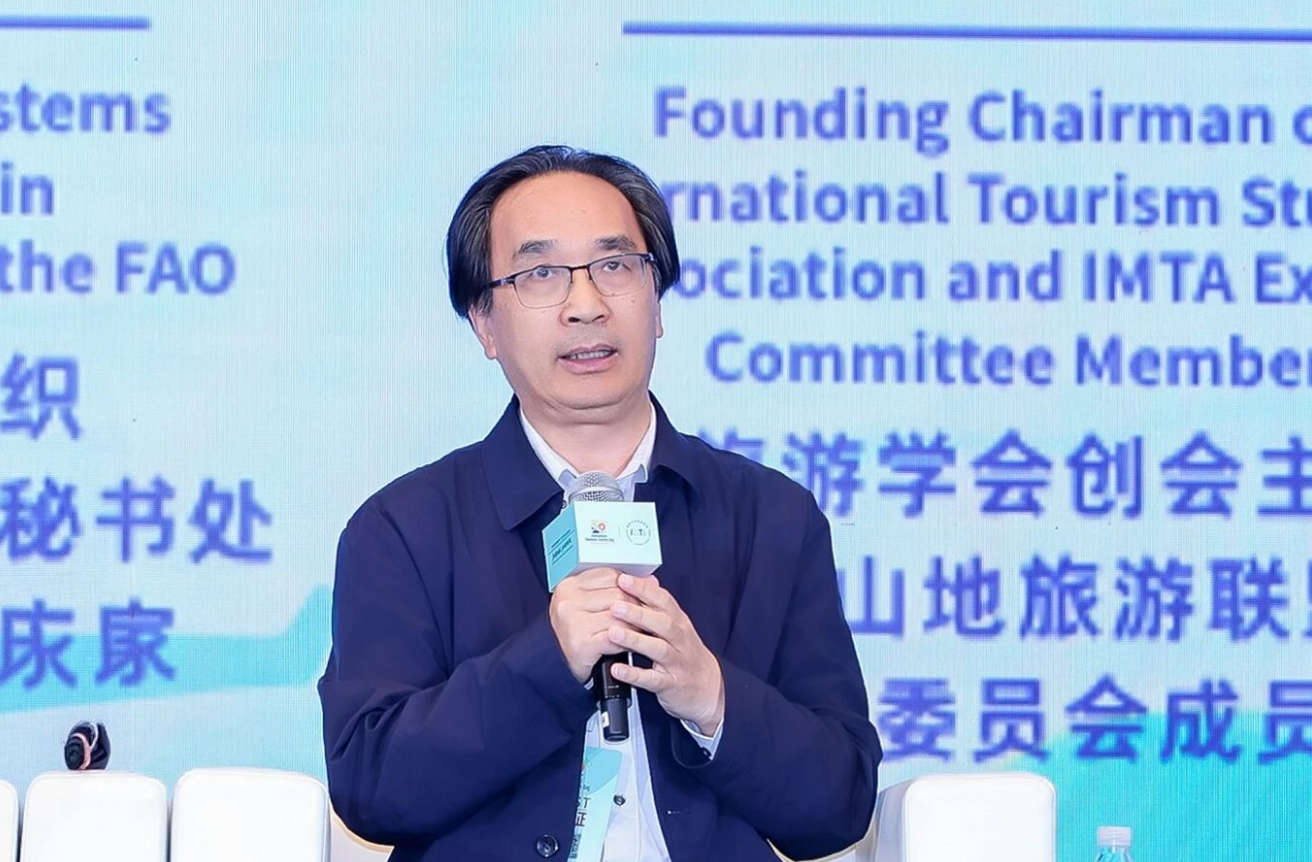
The following is the full text of the speech:
The trust that the successive leadership of the International Mountain Tourism Alliance (IMTA) has placed in our team has enabled us to carry out the research and drafting of standards for World Famous Tourism Mountains. World Famous Mountains or world-class protected areas already have various standards such as dual heritage and triple heritage. However, we have noted the unique nature of the concept "World Famous Tourism Mountains" — it requires not only that the mountain is famous, has scientific value, and holds conservation significance, but also that it is visitor-friendly. Therefore, the standards cover two aspects: first, natural conservation value and aesthetic value; second, service quality and visitor experience. This standard differs from other natural standards in that it requires both natural value and service quality.
Within the standard, two dimensions are proposed: natural value and cultural value. Globally, it is common for mountains to embody both culture and nature. However, the situation in China is somewhat different — natural protected areas are managed by the National Forestry and Grassland Administration, with a primary focus on conservation. Five national parks have already been established, and over 40 more are planned for the future, all centered on protection. The only exception is the Scenic and Historic Areas Regulation, which involves cultural elements. National cultural parks, such as the Great Wall, the Yellow River, and the Grand Canal, are linear in distribution, spanning multiple provinces. China's national parks mainly refer to national natural parks. World Famous Tourism Mountains should encompass four dimensions of sustainability: sustainable ecological resources, sustainable cultural heritage, sustainable community livelihoods, and sustainable enterprise investment.
In terms of China's practice, Shennongjia and Wuyi Mountain represent different models respectively. Shennongjia, home to the most complex and richest ecosystem in the subtropical region, focuses on natural protection. Wuyi Mountain, a World Dual Heritage site, balances natural protection and cultural heritage. Both demonstrate that natural protection and cultural preservation are equally important in mountain tourism.
Regarding the provision in the National Park Law that "no human activity is allowed in core protected areas," from a scientific perspective, a more reasonable formulation would be "strictly restrict human activity." The theme of this roundtable dialogue is "Striking a Balance between Tourism Development and Ecological Conservation," and the key lies in scientific balance. Scientifically speaking, ecological red lines are a matter of management and administration, not naturally existing boundaries. The delineation of ecological red lines should vary according to the objects of protection — the protection measures for subtropical zones, tropical rainforests, and alpine regions should differ, as should the management approaches for karst landscapes and bird sanctuaries. At the same time, management should vary by season and by different types of tourism activities. Achieving a balance between tourism development and ecological protection requires following both the "way of science" — which calls for scientifically-based policymaking — and the "way of governance" — which requires management authorities to take responsibility.
The conclusion is: we must protect and develop simultaneously, and the key lies in applying science.
Unless otherwise credited, all text and images are sourced from: International Mountain Tourism Alliance (IMTA)
Editor Ⅰ: Zhang Congxiao
Editor Ⅱ: Zhang Wenwen
Editor Ⅲ: Liu Guosong