


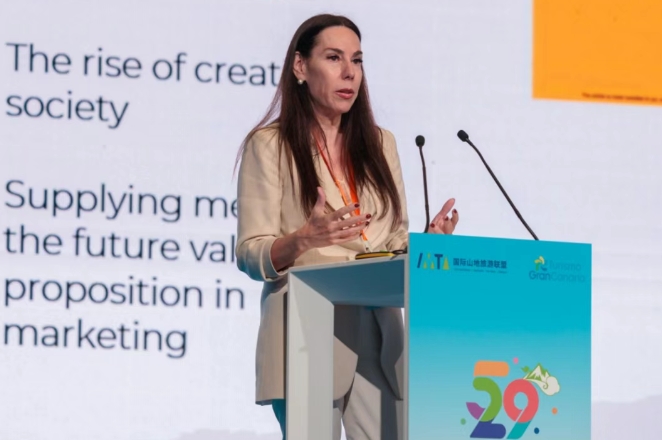
On May 29, the"International Mountain Tourism Day 2025" Theme Events kicked off on Gran Canaria, Spain. With the theme "Embracing Mountains and Seas, Coexisting with Cultures — Mountain Tourism and Cultural Inclusiveness for the Future," the event brought together representatives from international organizations, government officials, industry leaders, experts, scholars, and media worldwide to explore inclusive collaboration and shared development in global mountain tourism. The program included an opening ceremony, thematic forums, mountain cultural exchange sessions, a China-Spain cultural tourism exhibition, and the "Gran Canaria Night" welcome dinner. Participants engaged in diverse formats to share advanced concepts, discuss cutting-edge issues, and deepen practical cooperation. Ms. Yolanda Perdomo, Travel and Tourism Board Advisor; Former Director of Madrid Tourism, Spain, delivered a speech at the"Innovation in Mountain Tourism & Local Community Participation" Theme Forum.
The full text of the speech is as follows:
The "2030 Wellness Report" released by the Global Wellness Institute focuses on a new paradigm of happiness. As shown in the figure, "nature" is one of the four pathways to achieve happiness. Nature is a core element of mountain tourism, so its connection with wellness and health is evident. The other three pathways presented in the report are culture, biohacking, and what the report's authors call "the art of living" (which, for the purposes of this conference, can also be defined as a refined form of leisure).
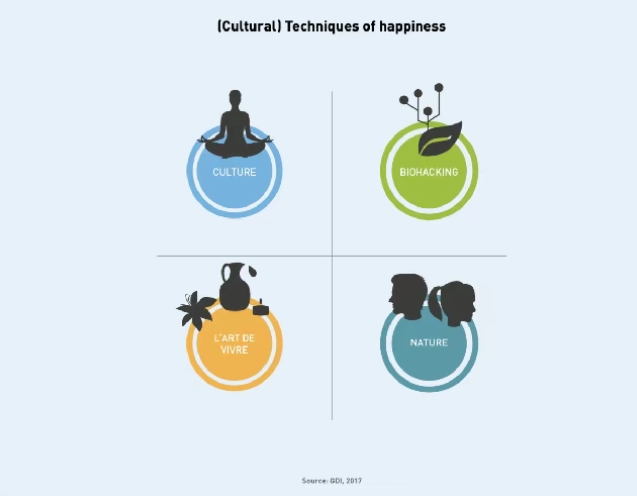
Therefore, these two emerging trends in mountain tourism are closely linked to people's pursuit of happiness, which is the intrinsic driving force behind the surge in demand. As we will see in the next slide, this phenomenon emerged before 2020 and is expected to grow exponentially in the following years, with the pandemic accelerating this process.
Academic evidence: Strategies from authoritative scholars
Several publications over the past decade have compiled this paradigm shift in consumer behavior.
In 2010, Philip Kotler systematically elaborated on the concept of the rise of creative groups (which are no longer a minority). To meet their needs, a differentiated strategy is required, namely "a combination of collaborative marketing, cultural marketing, and spiritual marketing". He specifically noted: "Endowing meaning will become the value proposition of future marketing."
In 2011, Porter and Kramer put forward the concept of shared value, adding a new element to corporate considerations that goes beyond traditional corporate social responsibility. This people-centered concept is not limited to a single department but runs through the entire enterprise and the social environment in which it operates, and is also closely related to meaning.
In 2014, "Conscious Capitalism" by Sisodia, Wolfe, and Sheth was published. They put forward the view that we are living in an era of excellence—because this is the state of life that more and more people in today's society are pursuing. People live longer and better lives, and begin to pursue excellence and leave a spiritual legacy. The authors also put forward the argument that many of today's most successful brands are driven by a sense of mission, which easily resonates highly with consumers. The Sustainable Development Goals adopted by the United Nations in 2015 extended this concept to all areas of society.

The pursuit of meaning and excellence is part of humanity's search for happiness. This trend was originally expected to develop gradually but was unexpectedly accelerated by a major变故 and has now become a reality. Because of this, wellness and leisure have also become core elements of mountain tourism. There are huge business opportunities here for those who can insight into the drivers of demand and flexibly design products accordingly.
Contemporary wellness tourism
Today, wellness has long gone beyond mere physical care. With the shift in consumer expectations, contemporary wellness focuses more on the overall health of the body, mind, and spirit.
This reminds us of the concept of transformative tourism. Its value proposition lies in promoting self-discovery and growth through transformative experiences.
As defined in the *Global Report on Transformative Tourism by Members of the World Tourism Organization Alliance* released in 2016, this type of tourism responds to the growing demand for people to change their lifestyles through tourism while having a positive impact on tourist destinations. It is also known as ultra-modern tourism, awakening tourism, etc.
Transformative travelers love a leisurely, refined, and simple way of life and advocate doing things themselves. Such travelers pay attention to interpersonal connections and communication, and seek in-depth experiences that can promote personal and collective development. Here again, we see the search for meaning.

What core elements, drivers, and catalysts need to be considered to promote the development of mountain tourism?
The core elements of correct product development should include healthy diet, meditation, yoga and fitness retreats, spa, hot springs, and comfortable travel experiences. At the same time, it is necessary to adopt the concept of leisurely travel, meet the demand for "screen-free vacations", and integrate the Asian characteristic way of getting close to nature.
We have already mentioned the driving factors earlier: people's pursuit of deep connections and the rise of the concept of awakening tourism. The catalysts are the increase in life expectancy, the pursuit of excellence, and spiritual satisfaction.
Outbound markets that prioritize wellness include China, South Korea, Thailand, Vietnam, and Japan.

Leisure in mountain value propositions
How to create leisure experiences? What core elements, drivers, and catalysts need to be considered to promote the development of mountain tourism?
Core elements to consider include food and wine tourism, sports, sightseeing and culture, forest bathing, wilderness/nature exploration, ecotourism, natural landscapes, farm experiences, and the rapid development of space tourism.
Drivers include the pursuit of activity-oriented experiences, travel motivation based on fun and enjoyment, a strong sense of adventure, the need for excitement and escape from reality, and enthusiasm for exploring niche and secluded places.
According to user portraits, the target customer groups can be divided into two categories: adventure travelers; and interest/hobby-oriented travelers.
Outbound markets focusing on adventure tourism include India, the United States, the Philippines, the United Kingdom, Canada, Australia, New Zealand, Malaysia, and Thailand.
Markets focusing on interest/hobby tourism are concentrated in Indonesia, Japan, Hong Kong (China), Malaysia, Germany, the United States, and New Zealand.

Leisure: The rise of food and wine tourism
For destinations with one of the above elements, this is an important strategic consideration. Food (gourmet food and wine) is a core resource for creating high-value-added tourism products for the following reasons:
- It provides a unique selling point. This is the key to successful positioning and marketing.
- This strategy is feasible because it is closely related to traditions, and the traditions of each place are unique. Showcasing the unique and authentic elements of a destination can ensure differentiation, thereby forming a competitive advantage.
- It can guide tourists to less-visited areas, helping to alleviate the problem of overtourism and creating opportunities for more stakeholders in the value chain.
- It can assist in strategic planning, effective communication plans, and engaging brand narratives.
- It can enhance tourist loyalty.
- It has a positive effect on alleviating seasonal problems.
Markets that focus on food tourism include: Spain, South Korea, Italy, France, Belgium, Australia, the United States (especially wine tourism), Japan, Singapore, Hong Kong (China), and India.

Leisure market segmentation
Target groups for different types of activities vary.
Taking natural landscapes as an example, their main customer groups are:
- High-consuming travelers
- Elderly singles/couples with children
- Tourists from Italy, France, Singapore, and the United Kingdom
Wilderness travel:
- High-consuming travelers
- Nature exploration enthusiasts
- Tourists from Germany and France
- Preferred landscapes: waterfalls, national and state parks, rivers, and lakes
Hiking:
- Young singles/couples without children
- Adventure and nature lovers
- Tourists from France, Thailand, and Canada
- Hiking: France
Leisure market segmentation
Outbound markets that focus on food tours include:
Vietnam, South Korea, Taiwan (China), China, and Thailand
Farm experience programs are mainly aimed at high-end travelers and family customers. Outbound markets that focus on them include:
- Singapore, China, Hong Kong (China), and Vietnam
- Canada, the United States, and New Zealand
Forest bathing:
- Tourists from Indonesia and Taiwan (China)
Cheese and chocolate workshops:
- Global market
Challenges
We have discussed many opportunities for mountain tourism in the fields of wellness and leisure, but we also face the following challenges:
- Need to protect local characteristic products and avoid homogenization
- Capacity building
- Need to adopt a pragmatic attitude towards responsibility, sustainability, and long-term strategic thinking, rather than just staying at the theoretical level
- Need to design and implement a governance model covering the entire value chain to ensure the consistency and legitimacy of the overall process (product development, positioning, marketing).
To sum up, if we can incorporate these considerations into the value proposition of mountain tourism destinations, we will usher in huge development opportunities. However, the most important thing is to understand the driving factors behind this trend. This will open a window of opportunity for us to promote further innovation, differentiated development, enhancement of competitive advantages, and even the realization of human happiness.
Source: IMTA
Editor Ⅰ: Zhang Wenwen
Editor Ⅱ: Bao Gang
Editor Ⅲ: Liu Guosong